Before the Pencil Play Activities That Prepare Children to Write
We often notice writing at the moment a child picks up a pencil.
The letter shape. The grip. The spelling. The sentence.
But writing does not begin with a pencil. It begins much earlier, in the hands, shoulders, core, eyes, ears, language, confidence and joy of a young child moving through play.
When children struggle to write, the answer is not always more pencil practice. Sometimes the child needs more climbing, squeezing, pouring, pinching, carrying, building, talking and pretending. These ordinary play moments are laying the foundations for writing long before a worksheet appears.
If we rush to the pencil before the body and brain are ready, writing can feel heavy. When development unfolds through rich play, something different happens. One day, almost quietly, the child is ready. And they write.

Writing is physical before it is cognitive
Writing looks like a thinking task. A child has to remember sounds, choose words, form letters and organise ideas. All of that matters. But before those cognitive demands can settle, the body has to do a huge amount of work.
To write comfortably, a child needs:
Shoulder stability
Core strength
Fine motor control
Bilateral coordination
Hand strength
Finger isolation
Visual-motor integration
Postural control
Attention and stamina
That is a lot for a five-year-old or six-year-old.
A child sitting to write must keep their body upright, stabilise the shoulder, control the elbow, move the wrist, isolate the fingers, track what the eyes see and connect movement to meaning. At the same time, they must think about sounds, words, directionality and spacing.
Occupational therapy research and practice often refer to the idea that proximal stability supports distal control. In plain English, a stable core and strong shoulders help the hands and fingers work with more control.
Strong shoulders support steady hands.
This is why a child may avoid writing even when they know what they want to say. The problem may not be effort. It may be that the act of holding the body still, gripping the pencil, pressing on the page and moving the fingers is genuinely tiring.
When writing feels physically exhausting, children may:
Press too hard or too lightly
Swap hands often
Complain that their hand hurts
Avoid mark-making
Rush through work
Say they cannot do it
Produce writing that looks less mature than their spoken ideas
These behaviours are easy to misread as reluctance. Often, they are signals that the child needs more physical preparation.
Play builds the body for writing
Look closely at what children naturally do in good early years provision. They climb, balance, lift, carry, build, push, pull, dig, pour, scoop, squeeze, stretch, thread, peg, pinch, cut and join.
These are not breaks from learning. They are learning.
A child rolling playdough is strengthening the small muscles inside the hand. A child climbing is building shoulder stability. A child carrying a crate of blocks is developing core strength. A child threading beads is refining finger control. A child using tweezers is practising the pincer grip they will later use to hold a pencil.
The preparation is everywhere.
Big movements come before small movements
Fine motor skills do not appear in isolation. Small controlled finger movements grow from larger body movements.
Children need chances to move their whole bodies:
Climbing frames
Obstacle courses
Crawling tunnels
Balance beams
Large-scale painting
Dancing with scarves
Sweeping with child-sized brushes
Carrying baskets of objects
Pushing and pulling crates or tyres
These activities strengthen the shoulders, back, tummy and arms. They also build body awareness. A child learns where their body is in space, how much force to use and how to adjust movement.
That matters for writing. Letter formation needs controlled movement, but control starts with the whole body.

Hands need strength, not just neatness
Young children’s hands are still developing. Asking for neat handwriting before the hand is ready can lead to tension, poor posture and frustration.
Play gives the hand a workout without making it feel like a test.
Useful hand-strengthening play includes:
Kneading dough
Squeezing sponges
Using spray bottles
Pegging number cards on a washing line
Scrunching tissue paper
Tearing paper for collage
Opening and closing small containers
Building with interlocking blocks
Using hole punches
Digging in sand or soil
These actions build endurance. They help children hold tools for longer and use pressure more effectively.
A pencil is a tool, but it is not the only tool that teaches the hand. In many cases, it should not be the first.
Everyday play teaches the movements hidden inside writing
Letter formation depends on patterns of movement. Children need to move up, down, across, around, over, under and through. They need to start, stop, change direction and control pressure.
Play teaches all of this in meaningful ways.
When a child draws roads for toy cars, they practise lines, curves and pathways. When they make spirals in shaving foam, they explore circular movement. When they paint with water outside, they use large arm movements that later shrink down onto paper.
Before a child writes the letter `m`, they may have made humps in sand, loops with ribbon, towers with blocks and tracks with cars. The body has rehearsed the movement in many ways.
Bilateral coordination helps both hands work together
Writing is not just a one-handed task. One hand holds the pencil. The other hand keeps the paper still. The eyes guide the movement. The body stays balanced.
Bilateral coordination means both sides of the body work together in a planned way. Children practise this when they:
Cut with scissors
Thread beads onto string
Hold paper while glueing
Open jars
Build towers
Roll dough with both hands
Use a knife and fork
Pour from one container to another
If a child has not had enough practice using both hands together, writing can become harder. The page slides. The pencil hand overworks. The child may twist their body or hold the paper awkwardly.
Simple play routines help both hands learn their roles.
Finger isolation prepares children for pencil control
Finger isolation means moving one finger without moving all the others. It is needed for controlled pencil movements, keyboard use, fastening buttons and many daily tasks.
Children practise finger isolation through:
Finger rhymes
Counting on fingers
Poking holes in dough
Pressing buttons
Using pipettes
Playing with small-world figures
Flicking spinning tops
Picking up tiny objects
Making fingerprints in paint
These playful actions help children learn that fingers can move separately and with purpose.
This is one reason songs and rhymes with actions are so powerful. They combine rhythm, language, memory and movement. The child is not only joining in. They are building a writing-ready brain and body.
Mark-making is the bridge between play and writing
There is a beautiful stage before formal writing where children make marks with purpose. They draw lines, dots, spirals, zigzags, circles and shapes. They may tell you, with complete confidence, what the marks mean.
This is not scribbling in the dismissive sense. It is communication.
A child might say:
“This is my shopping list.”
“That says mummy.”
“These are the tickets.”
“I made a map.”
“This is the sign for the shop.”
At this stage, the meaning often matters more than the accuracy. The child is learning that marks can carry a message. That idea sits at the heart of writing.

Children need many ways to make marks
Pencils are useful, but they are not the whole story. Before expecting children to form letters on lined paper, offer mark-making in varied, low-pressure ways.
Good options include:
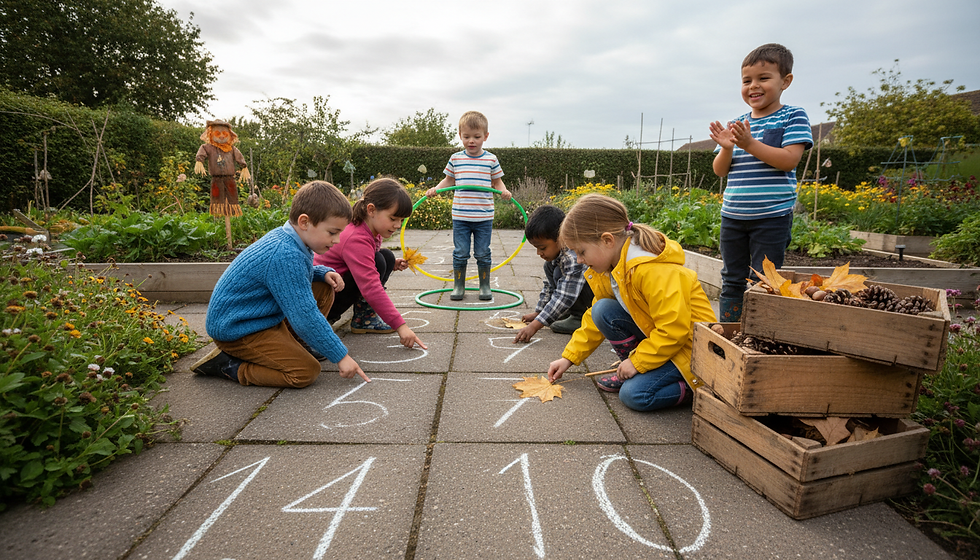
Chalk on the playground
Paintbrushes with water on a wall
Sticks in mud
Fingers in sand
Chunky crayons
Whiteboards and pens
Clipboards in role play
Large paper on the floor
Paint rollers
Ribbon sticks
Foam or shaving foam trays
Large-scale mark-making is especially helpful. It lets children use the whole arm and shoulder. Over time, those large movements become smaller and more controlled.
Writing readiness grows through repetition, but repetition does not need to feel repetitive.
Talk gives writing something to say
Writing is physical, but it is also language. Children need words before they can write words. They need stories before they can compose stories. They need experience before they can describe experience.
Play creates reasons to talk.
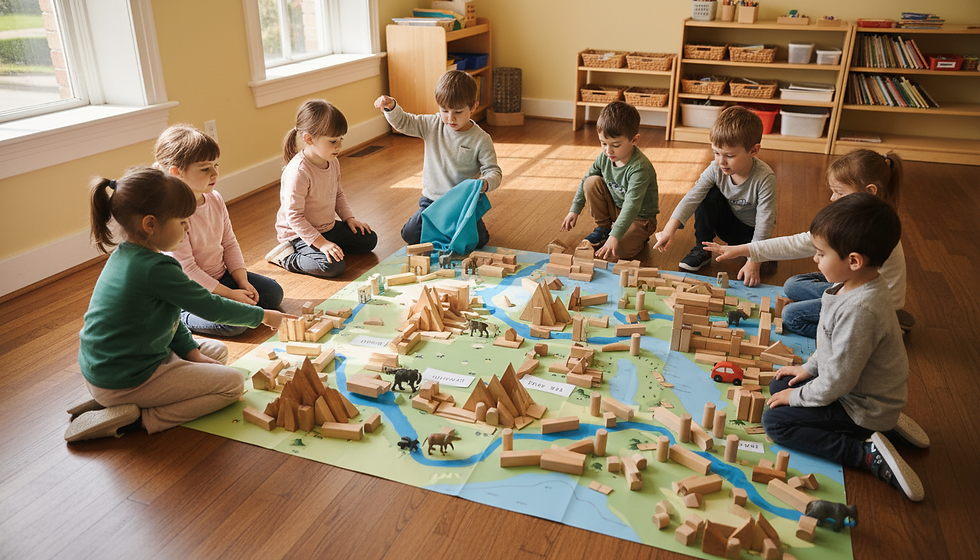
In role play, children negotiate roles, invent problems and build storylines. In construction, they explain plans and test ideas. In small-world play, they create characters and events. In messy play, they describe texture, change and cause.
All of this feeds writing.
A child who has spent the morning building a rescue station may later want to make a sign, a map, a list of equipment or an emergency message. Writing has a purpose because play created one.
This is much more powerful than asking a child to write a sentence with no context.
Adults can support without taking over
The adult role matters. Children need space to explore, but they also benefit from sensitive language and modelling.
Helpful adult prompts include:
“Tell me about what you’ve made.”
“What could we write on the sign?”
“Shall I write your words down?”
“What sound can you hear at the start?”
“Where should the list go?”
“I wonder how we could make a label for that.”
The aim is not to turn every play moment into a writing lesson. The aim is to notice natural openings where writing has meaning.
When adults model writing for a real reason, children see its value. A note, label, recipe, name tag, map or message shows that writing does something.
Readiness is not the same as waiting passively
Respecting development does not mean doing nothing. It means offering the right experiences at the right time.
Before the Pencil Play Activities That Prepare Children to Write are active, rich and intentional. They build strength, coordination, language and confidence without pushing children into tasks they are not ready to sustain.
Readiness can be supported through a balanced environment:
Physical play | Fine motor play | Meaningful mark-making |
Climbing, crawling, balancing and carrying | Threading, pegging, cutting and squeezing | Drawing, painting, labelling and pretend writing |
Builds core and shoulder stability | Builds hand strength and finger control | Builds purpose, symbols and confidence |
Supports posture and stamina | Supports grip and tool use | Supports early composition |
This kind of provision values the whole child. It recognises that the child building a den, squeezing dough or making a pretend café menu may be doing exactly the work needed for future writing.
Signs that a child is becoming ready to write
Readiness does not arrive all at once. It appears in small signs.
A child may be moving towards writing when they:
Choose to make marks during play
Give meaning to their drawings or symbols
Use one hand more consistently for tools
Hold paper with the other hand
Show interest in names, labels and signs
Copy simple shapes
Join in with action rhymes
Use tweezers, pegs or scissors with growing control
Sit for short purposeful tasks without strain
Talk about what they want their marks to say
These signs are more useful than a narrow focus on age. Children develop at different rates. Some are ready for more formal writing early. Others need more time strengthening the foundations.
The goal is not to hold children back. The goal is to help them move forward without making writing feel like failure.

The pencil comes after the preparation
There is nothing wrong with pencils. Children need to learn how to use them. They need to form letters, hear sounds, spell words and write sentences.
But the pencil should sit within a wider picture.
A child who has climbed, carried, squeezed, threaded, poured, sung, talked, drawn, pretended and painted arrives at writing with a stronger body and a clearer reason to write. The pencil is no longer a heavy demand. It becomes one more tool for expression.
The small moments matter:
The child rolling dough into “sausages”
The child pegging socks onto a line
The child drawing a map for a friend
The child painting giant circles outside
The child cutting tape for a cardboard model
The child writing pretend orders in a café
The child making a sign that says “Keep out”
These are not extras. They are the path.
When children play deeply, their bodies and brains are busy preparing. The hand grows stronger. The shoulder steadies. The fingers learn precision. The eyes follow movement. The mouth finds words. The mind discovers that marks can mean something.
Then, one day, the pencil is not a battle.
It is simply the next step.