The Neuroscience of 5–7 Year Olds And Why Play Is How They Learn Best
Updated: Aug 30
Five, six and seven year olds are not miniature adults. They are not unfinished Year 6 pupils. They are in one of the most sensitive and dynamic periods of brain development they will ever experience.
And the science, including UK research, is very clear about something important:
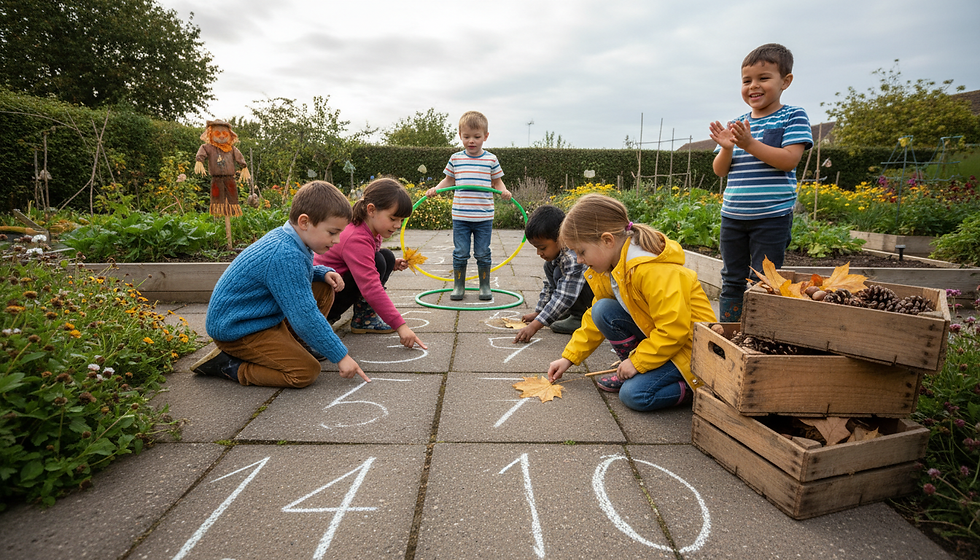
At this age, children learn best through active, social, meaningful play. Not because it looks charming. Not because it feels nostalgic. But because their brains are wired for it. Let’s look carefully at why.

The Developing Brain at 5–7
By the age of five, a child’s brain has reached around 90% of its adult size (Lenroot & Giedd, 2006). But development is not about size, it is about connectivity. Neural connections are forming, strengthening and pruning at remarkable speed. Experience shapes architecture. Repeated experiences strengthen pathways.
Unused connections fade.
The prefrontal cortex — responsible for:
• Self-regulation
• Working memory
• Planning
• Flexible thinking
• Inhibitory control
— is still very much under construction. This development continues into the mid-twenties (Center on the Developing Child, Harvard University, 2011).
In simple terms: Executive function is developing. And play is one of the most powerful ways to strengthen it.
Executive Function: What UK Research Says
The UK’s Education Endowment Foundation (EEF) has consistently identified metacognition and self-regulation as having among the highest impact on pupil progress.
The EEF’s guidance report Improving Social and Emotional Learning in Primary Schools (2019) emphasises that self-regulation is foundational to academic success.
Similarly, Professor Claire Cameron and colleagues’ work on executive function has shown that early self-regulation strongly predicts later academic outcomes.
In the UK, Professor Paul Howard-Jones at the University of Bristol has explored the neuroscience of learning, highlighting how motivation, emotion and cognition are deeply interconnected.
Executive function includes:
• Holding information in mind
• Adapting strategies
• Resisting distraction
• Persisting through challenge
Play strengthens these daily.
When a child:
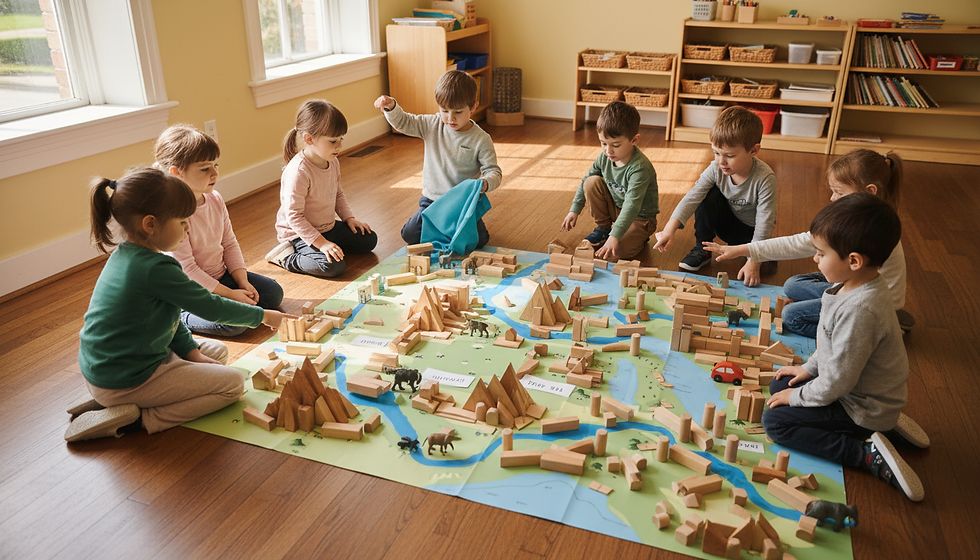
• Plans a build
• Revises after collapse
• Negotiates turn-taking
• Returns to unfinished work
They are exercising executive control. This is neurological strengthening. Not accidental. Not secondary. Foundational.

Emotion, Stress and Learning
Research from the Anna Freud Centre in London has highlighted the significant impact of emotional wellbeing on learning capacity.
Stress affects working memory. Anxiety narrows cognitive flexibility. Emotional dysregulation disrupts attention. Neuroscience confirms that chronic stress can impair hippocampal functioning, affecting memory consolidation (Center on the Developing Child, 2014).
Play-based learning reduces unnecessary stress by:
• Allowing private revision
• Reducing public comparison
• Encouraging autonomy
• Embedding collaboration
Emotionally safe environments support cognitive growth. This is not softness. It is brain protection.
The Importance of Talk: UK Oracy Research
The Education Endowment Foundation and organisations such as Voice 21 have highlighted the central role of spoken language in academic success. The EEF’s guidance on oral language interventions shows strong positive impact, particularly for younger learners. Language is not an add-on. It underpins literacy.
Play-based environments multiply authentic talk:
• Negotiation
• Explanation
• Storytelling
• Reasoning
Vygotsky’s theory of social learning, supported by decades of subsequent research, aligns with modern neuroscience: children think out loud before they think internally. Play provides space for that rehearsal.

Movement and Cognitive Development
Professor Adele Diamond’s work (widely referenced in UK educational policy discussions) shows that physical activity improves executive function.
UK-based research reviews, including those referenced by the EEF, confirm that physical engagement supports attention and self-regulation. Young children are neurologically wired for movement.
In play-based classrooms, children:
• Lift and carry
• Balance and build
• Manipulate materials
• Engage in fine motor exploration
Movement increases blood flow to the brain. It supports neural activation. It stabilises regulation. Stillness before regulation can be counterproductive. Movement before abstraction aligns with development.
Repetition Strengthens Neural Pathways
Children often repeat the same play scenario. Build the same structure. Revisit the same narrative. Return to the same area daily. From a neurological perspective, this repetition strengthens synaptic pathways. Neural circuits become more efficient with use.
Mastery requires repetition. The difference in play-based learning is that repetition is self-chosen. Self-chosen repetition activates intrinsic motivation systems in the brain, strengthening dopamine pathways associated with persistence and reward (Howard-Jones, 2014). Repetition in play is not stagnation. It is consolidation.

The UK Conversation Around Transition
The revised Department for Education EYFS Framework (2021) emphasises communication, physical development and personal, social and emotional development as prime areas. Yet in many settings, Year 1 shifts rapidly to sedentary, heavily recorded learning.
UK transition research, including studies referenced in Ofsted reports, indicates that abrupt pedagogical change can reduce engagement and increase anxiety.
Brains do not change developmentally because a school year changes. Continuity supports neurological stability. Continuous Provision in KS1 provides that continuity while increasing challenge.
Why Play Aligns With Brain Development
When we step back and look at the neuroscience and UK research together, the pattern is clear.
5–7 year olds need:
• Movement
• Emotionally safe environments
• Social interaction
• Repetition
• Autonomy
• Structured challenge
Play provides all of these. Not instead of curriculum. But as the method through which curriculum becomes embedded.
Five, six and seven year olds are still wiring their brains. Executive function is forming. Emotional regulation is stabilising. Language networks are expanding. Working memory is developing. Play is not the opposite of academic learning. It is the biological pathway through which it becomes secure. The neuroscience is clear. The UK research is consistent.
When we protect play in KS1, we are not resisting progress. We are aligning with evidence. And when pedagogy aligns with development, children thrive, not just now, but long term.
That is not nostalgia. That is responsibility.

Key References (Including UK Research)
• Center on the Developing Child (2011, 2014). Harvard University.
• Diamond, A. (2013). Executive functions. Annual Review of Psychology.
• Education Endowment Foundation (2019, 2021). Social and Emotional Learning; Oral Language Interventions.
• Howard-Jones, P. (2014). Neuroscience and Education. University of Bristol.
• Lenroot, R. K., & Giedd, J. N. (2006). Brain development in children and adolescents.
• Anna Freud Centre (2020+). Research on wellbeing and learning.
• Department for Education (2021). EYFS Framework.